The Lexus RX debuted in 1999 when mid-size SUVs were typically based on truck platforms. It distinguished itself from the rest with its car-based platform, which arguably made it the first luxury crossover SUV, and despite criticism for its lack of off-road abilities or towing brawn, the RX became a rousing success, and every other manufacturer followed its lead.
A quarter of a century later, the Lexus RX remains a staple in the lineup, bookended by the smaller UX and NX models and the larger TX, GX, and LX SUVs. As with its siblings, the RX benefits from Lexus' well-deserved reputation for comfort and reliability.
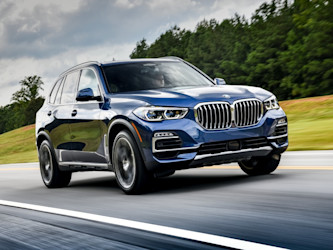
It also undercut its European rivals by a sizeable margin on list price and, while it may not be as opulent as a Mercedes GLC or as sporty as a BMW X5, Lexus focuses on what the majority of luxury clients want: comfort and refinement.
Lexus RX Buying Guide: Cost, Reliability, and the Best Years to Buy
- Frequently Asked Questions
- Lexus RX Pros and Cons
- Lexus RX Generations
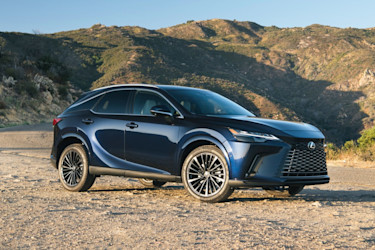
- Fifth Generation (2023 - present)
- Fourth Generation (2016 - 2022)
- Third Generation (2010 - 2015)
- Second Generation (2004 - 2009)
- First Generation (1999 - 2003)
Frequently Asked Questions
Which Lexus RX years are the best?
It depends on what you're looking for. The latest fifth-generation RX is the most efficient and technologically advanced, but most models aren't as powerful as their predecessors. Unfortunately, the fourth-generation RXs also came with one of the worst multimedia interfaces ever installed in a vehicle, which could be a dealbreaker for many. Considering how reliable the Lexus RX is, it's one of the few luxury vehicles that can be considered a smart alternative on the used market. You won't get all of the latest features or the best mileage, but an older RX should be comfortable and trouble-free.
Which Lexus RX years are the worst?
No RX generation could be considered bad, but the first few model years are notable for their lack of safety features. At the time, it had all the items you might expect, but the RX's production run spans one of the most active periods for new technology. More modern RX models have lots more features, many of which are standard on all trim levels. That leads us to recommend the fourth- and fifth-generation models, especially for family-focused buyers.
Is the Lexus RX a good deal?
The Lexus RX has held its value better than the average luxury SUV, and that applies to all generations. That means you might spend a little more if you're purchasing a pre-owned example, but by all accounts, you should make up for it when you decide to sell.
Lexus RX Pros and cons
Pros:
- Superb reliability
- Refined and comfortable second generation
- Strong resale values
Cons:
- Expensive compared to used rivals
- Primitive first-generation models
- Rivals are better for towing and off-road
Lexus RX generations
Fifth Generation (2023 - present)
An all-new RX debuted for the 2023 model year with a bold styling direction that divided opinion. The grille grew to comically large proportions, dominating the entire front fascia, while other unusual design elements included some awkward body contours that wrap around the rear wheel arches and chrome trim that attempts to mimic a floating roofline.
There were big changes throughout the lineup, including the discontinuation of the seven-seat RX L version, rendering the current RX a two-row model only, and a substitution for the six-cylinder engines. The RX 350 name continued, even though it was powered by a 2.4-liter four-cylinder engine that produced 275 horsepower and 317 lb-ft of torque. An eight-speed automatic transmission sent power to the front wheels.
The hybrid option was renamed the RX 350h and equipped with a 2.5-liter four-cylinder hybrid engine and CVT up front, with an electric motor in the back for standard all-wheel drive (AWD), known as Lexus' Direct4 system. Power output dropped to 246 horsepower and 233 lb-ft of torque but, curiously, this RX was marginally quicker than its predecessor.
The Base model offered the likes of a power liftgate, tri-zone climate control, a new infotainment system with a 9.8-inch touchscreen, and Lexus' Safety System+ 3.0, which comprises a suite of safety features including adaptive cruise control, automatic emergency braking, a blind-spot monitor, and lane-keep assist. Wireless phone charging became standard for the 2026 model year.
The Premium trim added roof rails, a sunroof, wood interior trim, ventilated front seats, a wireless phone charger, and parking sensors. Premium+ dressed things up with ambient interior lighting, leather upholstery, a heated wood-trimmed steering wheel, and a larger touchscreen. The F-Sport model livened up the driving experience with sport-tuned suspension, upgraded brakes, sport seats, racy styling elements, and a head-up display. The top Luxury trim finished off the features list with premium leather, a panoramic sunroof, a Mark Levinson premium audio system, surround-view cameras, a semi-automated parking system, and a hands-free driving function for dense traffic.
Two new hybrids joined the lineup for the 2024 model year: the RX 450h+ was a plug-in hybrid (PHEV) with a much bigger battery that allowed for an estimated 37 miles of electric-only range. The RX 500h F Sport Performance used its hybrid system for performance over efficiency. It had a 2.4-liter turbo four-cylinder hybrid, a power output of 366 horsepower, 406 lb-ft of torque, and was only offered in F Sport Performance trim.
Aside from the new RX500h, handling was similar to the previous RX, with comfort prioritised over performance, and even the sportier models weren't all that sporty. On top of that, the F-Sport suspension negatively affected ride comfort for negligible handling improvements.
The standard RX 350's fuel economy improved yet again this generation, with an estimated 22/29 mpg city/highway for the front-wheel drive (FWD) model, while AWD drops by one mpg. The RX 350h hybrid is the mileage leader of the lineup, with a 37/34 mpg city/highway estimate, but the RX 500h still returns strong numbers, at 27/28 mpg city/highway. The plug-in RX 450h+ is estimated at 36/33 mpg city/highway once the battery is depleted.
The fifth-generation RX received five-out-of-five stars in all overall and side crash protection and four stars in frontal and rollover tests. The Insurance Institute for Highway Safety (IIHS) awarded the RX its highest score of "Good" in all but the new moderate overlap frontal test, where it received the lowest score of "Poor." That was still good enough for a Top Safety Pick+ rating for 2023, though it was downgraded to a regular Top Safety Pick the year after and hasn't received any Top Safety rating since. Recalls were light for this generation, with only minor issues with the airbag and headrests.
A brand-new 2026 Lexus RX starts at $51,175, though you'll pay more for the hybrid ($53,475) and the plug-in ($66,680). Average used pricing ranges from about $44,400 to $60,000, depending on the model year and powertrain.
Fourth Generation (2016 - 2022)
The fourth-generation RX introduced a sharper and sleeker design, although the styling drew some criticism for the oversized spindle grille. It was almost five inches longer than the previous model and increased ground clearance by almost a full inch. On paper, cargo space shrunk to only 18.4 cu-ft, but in reality, that was due to a change in the way Lexus reported cargo volume, measuring to the top of the rear seatbacks rather than to the headliner. The sharply raked rear liftgate did cut into space, though, and made it harder to load bulky items.
The Lexus RX 350 continued with a 3.5-liter V6, but power increased to 295 horsepower and torque to 267 lb-ft. The transmission was also upgraded to eight speeds. The hybrid RX 450h's output increased to 308 horsepower and 247 lb-ft of torque, but the drivetrain changed significantly, as the gas V6 was paired with two electric motor/generators and a continuously variable transmission (CVT). FWD was standard, while models fitted with an AWD system gained a third electric motor for the rear wheels, with no power routed from the primary engine.
Inside, the RX's dashboard lost the previous generation's organic curves in favor of a more upright and traditional look. The quality of the materials improved, too, with more soft-touch surfaces and stronger plastics, while passenger space was increased for both the front and the rear seats. Optional safety features included a blind spot monitor with rear-cross traffic alert, adaptive cruise control, frontal collision warning with automatic braking, lane-departure warning, and lane departure intervention. All were standard on the hybrid RX 450h in 2017, except for the blind-spot monitor, which was included in 2021.
A longer, three-row variant called the RX 350L debuted in 2018, but its rearmost seats were so cramped they were barely suitable for children. It wasn't very popular, and only stuck around until 2022. The blind spot monitor was standardized in 2018, and from 2019, owners could remotely monitor and control certain functions of the car via the Lexus Enform smartphone app.
The biggest change happened for 2020, with a styling refresh for the front and the rear. The RX also got a suspension retune for sportier handling and a few more standard safety features, including lane centering, frontal collision warning with automatic emergency braking, and a traffic sign reader. Apple CarPlay and Android Auto were finally added this year, but Remote Touch was changed to a trackpad-like controller, which made it considerably less intuitive and complicated even basic functions. For 2021, a wireless charging pad was added.
Fuel efficiency increased slightly for the RX 350, registering a 20/27 mpg city/highway estimate for the FWD model, while the RX 450h remained essentially the same, at 31/30 mpg city/highway. In general, the three-row RX 350 L and the RX 450h L surrender one mpg to the standard RXs, and these figures varied only slightly over the fourth-generation's production run.
The fourth-generation RX received four-out-of-five stars in all National Highway Traffic Safety Administration (NHTSA) crash tests, and five stars for side impact protection. The 2017 RX rose to five stars overall and four stars for frontal and rollover protection, and in 2022, the overall score dropped to four stars. The IIHS awarded its best score of "Good" across all evaluations and named the RX a Top Safety Pick+, the Institute's new top award. It was downgraded to a Top Safety Pick in 2018.
Airbag issues and a faulty brake actuator resulted in a few recalls in 2016 and some fuel pump problems that continued into the 2020 model year. The relatively low number of recalls, combined with the RX's continued reliability, led to strong resale values. Early fourth-generation RXs fetch upwards of $18,000 on the used car market, while later model years remain around $35,000.
Third Generation (2010 - 2015)
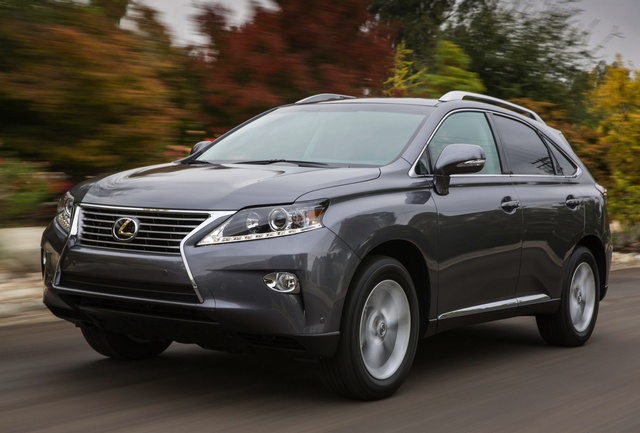
The RX's third generation began with the 2010 redesign. The RX 350 continued with its V6 powertrain, though output increased slightly to 275 horsepower and 257 lb-ft of torque, and the transmission was upgraded to six gears. The hybrid was renamed the RX 450h, signifying that it now had the 3.5-liter V6, and power output grew to 295 horsepower.
Standard features remained similar to the previous generation's, though keyless entry and ignition were added. Options included sport-tuned suspension, a power liftgate, leather upholstery, ventilated front seats, power-folding mirrors, a navigation system, a rearview camera, a Mark Levinson premium audio system, a head-up display, and Bluetooth, while a new mouse-like infotainment controller was added to the center console.
Exterior dimensions and styling also remained somewhat similar, though sharper body creases added visual flair. The interior received a much more significant makeover, with distinctive curves as opposed to the previous dashboard's comparably rigid and upright design. Back-seat passengers lost an inch in headroom, but behind those seats, cargo capacity increased to 40 cu-ft.
Changes were pretty light for the first few years, before a refresh in 2013 when the RX adopted Lexus' signature spindle grille. An available F-Sport package added sharper exterior styling, sports suspension, and an eight-speed transmission. A household power outlet and Siri Eyes Free iPhone control were added in 2014 and, in its final year, a larger infotainment display and a rearview camera were standardized.
Safety features grew to include no less than 10 airbags, including a full-length side curtain airbag. Adaptive cruise control debuted in this generation and, with it, frontal collision warning and a blind spot monitor, but these were optional. Technology-wise, the Safety Connect emergency telematics system was standard.
The third-generation RX received five-out-of-five stars in all NHTSA crash tests and four stars for rollover protection. Similarly, the IIHS awarded its best score of "Good" across all evaluations and named the RX a Top Safety Pick, which was the Institute's highest honor at the time. In subsequent years, some of the NHTSA scores varied between four and five stars. Recalls for this RX generation were light; the floor mat issues continued into the 2013 model year and, in 2011, a recall was placed for a faulty brake actuator.
Third-generation RX 350s had slightly better fuel economy estimates than their predecessors, at 18/25 mpg city/highway for front-drive and 18/24 mpg city/highway with AWD. The RX 400h hybrid was estimated at 32/28 mpg city/highway and 30/28 mpg city/highway for front- and AWD, respectively. These figures varied only by one mpg over the production run.
Reliability was the name of the game for the Lexus RX once again, as it delivered a relatively trouble-free ownership experience. As a result, pre-owned prices remain between $10,000 and $15,000.
Second Generation (2004 - 2009)
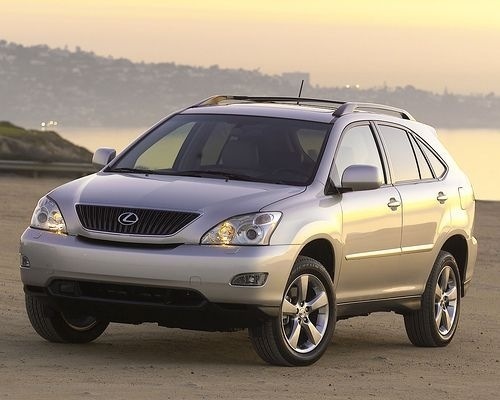
The RX was completely redesigned for the 2004 model year, although the new styling wasn't a big departure from its predecessor inside or out. It was renamed the RX 330 to reference the larger and more powerful engine, a 3.3-liter V6 that produced 230 horsepower and 242 lb-ft of torque. The transmission was upgraded to five gears and AWD replaced four-wheel drive (4WD), but towing capacity dropped to 2,000 lbs.
The second-generation RX was six inches longer than the first, which increased cargo capacity to 39.8 cu-ft, while rear passenger space remained nearly the same. Those passengers also benefited from sliding and reclining seats, while new features included dual-zone automatic climate control and optional sport-tuned air suspension.
For 2005, a power liftgate was added to the standard features list, along with a wooden steering wheel and shift knob, Bluetooth, and a single CD player that replaced the previous six-disc changer.
The following year, the lineup expanded to include Lexus' first hybrid model: the RX 400h. It added three electric motors to the V6 powertrain that increased power output to 268 horsepower. The standard RX 330's power rating was also adjusted to reflect the new Society of Automotive Engineers (SAE) standard, dropping to 223 horsepower. This model was more generously appointed than the non-hybrid, with standard leather upholstery and a sunroof.
The RX 350 arrived in 2007 and, as the name suggests, the engine grew to 3.5-liters, power output increased to 270 horsepower and torque to 251 lb-ft. The RX 400h hybrid made the leather upholstery and sunroof optional, making the standard car more affordable in the process. For 2008, the exterior was refreshed with a new grille and more chrome accents.
The RX 330 models were estimated by the EPA to return 17/24 mpg city/highway with FWD, and 16/22 mpg city/highway with AWD and, as before, these estimates fluctuated by an mpg or two over this generation. The RX 400h hybrid easily beat those estimates with a 28/25 mpg city/highway rating for FWD and 27/25 mpg city/highway for AWD. Despite being larger and more powerful, the 2007 RX 350 received more efficient estimates than the RX 330, with 18/23 mpg city/highway for FWD and 17/22 mpg city/highway with AWD.
New safety features included standard side airbags for both seating rows, as well as knee airbags for the driver. The NHTSA awarded the RX five-out-of-five stars across the board, except for front passenger protection, which received four stars. The IIHS also awarded the RX its highest score of "Good" in crash tests.
Recalls for this generation are about as light as those of the previous RX. In its first year of production, they were ordered for the engine crankshaft pulley, the brake master cylinder, the rear seat belts, and the brake lights. Another was issued for the floor mat anchors, which received blame for some unintended acceleration accidents.
As with its predecessor, the second-generation RX models were just as reliable. That helped to keep values strong, and you can expect to pay between $5,000 and $7,000 for a pre-owned example.
First Generation (1999 - 2003)
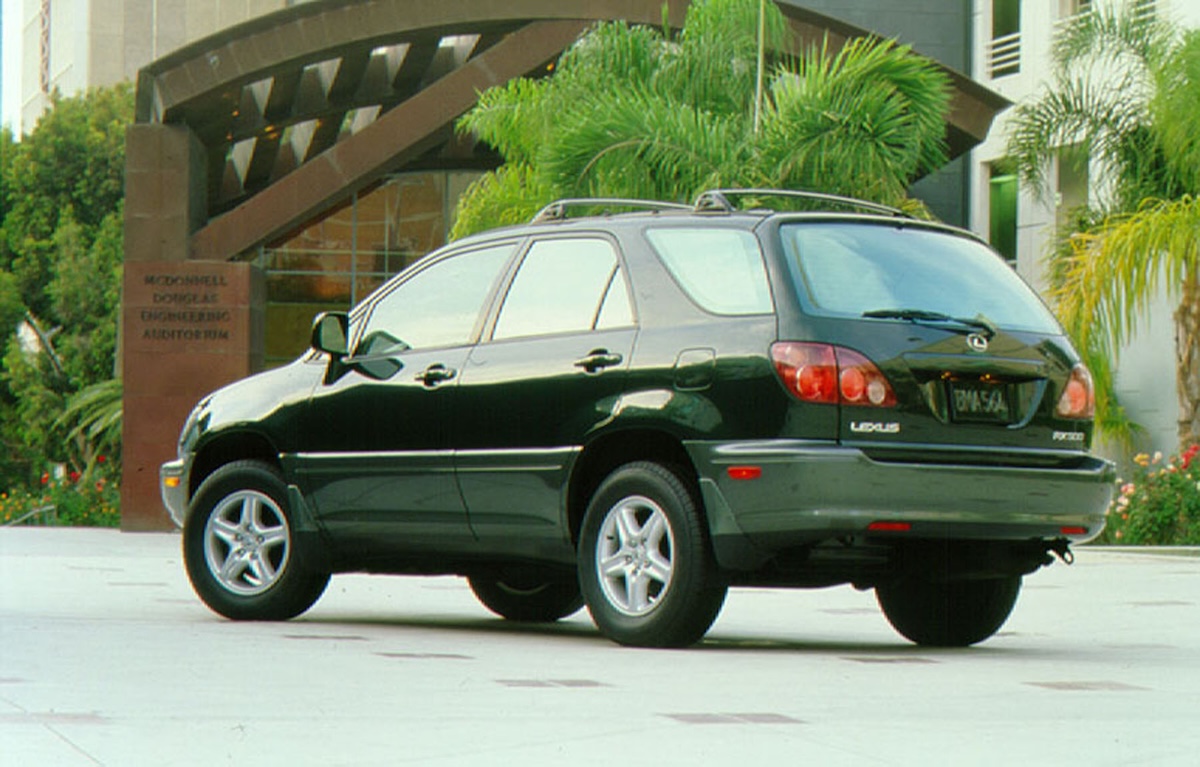
The original Lexus RX was considered the first luxury crossover SUV, with its elevated ride height and unibody construction, and it shared some of its chassis components with the Toyota Avalon and Camry sedans.
The inaugural RX 300 was powered by a 3.0-liter V6 engine that produced 220 horsepower and 222 pound-feet of torque. A four-speed automatic transmission sent power to the front wheels and full-time 4WD was offered as an option. Unlike other 4WD vehicles, the RX lacked a low-range transfer case to maximize traction when off-roading. As such, the RX was intended more for slick streets and snow instead of all-terrain adventures. Properly equipped, these models could tow as much as 3,500 pounds.
At the time, the closest rivals were the Mercedes-Benz ML 320 and the Jeep Grand Cherokee, both of which were body-on-frame vehicles, which allowed for improved towing and off-roading, but compromised handling and ride quality. The Lexus RX instead concentrated on where owners were driving the most—on city streets and highways. While some critics initially deducted points for its lack of off-road abilities, it quickly became clear that Lexus had figured out what buyers wanted, and other luxury carmakers followed suit.
The Mercedes-Benz ML needed almost 10 seconds to accelerate to 60 mph, but the RX got there in 8.2 seconds—although the V8-powered Jeep Grand Cherokee was the quickest, at 7.2 seconds. The RX could hold up to 30 cubic-feet of cargo behind the rear seats, which is about 10 cu-ft less than the ML or the Grand Cherokee.
Standard features included typical luxury items of the time, such as power windows and locks, cruise control, and power-adjustable front seats. Options included a Nakamichi premium audio system, a sunroof, and leather upholstery. On the safety side, it came with main and side airbags for the front seats and stability control was an option.
For the 2001 model year, the RX gained traction and stability control (known as VSC-Vehicle Skid Control) as standard equipment. It also received some minor cosmetic changes to the lights and grille, plus a larger Lexus badge. Other new features included a 19.8-gallon fuel tank, new cloth and leather upholstery, child seat anchors, and a pre-wired tow receiver for 4WD models. There were also some new options for HID headlights, a wood-trimmed steering wheel and shift knob, heated seats, and a DVD-based navigation system. In 2002, the Nakamichi audio system was replaced with a Mark Levinson unit.
The front-drive 1999 RX 300 was estimated by the EPA to return 17 mpg in the city and 22 mpg on the highway. 4WD reduces that estimate to 17/20 mpg city/highway and, year after year, these estimates fluctuated by a single mpg up or down for this generation.
IIHS crash tests resulted in good scores for the first-generation Lexus RX 300, and there were seven recalls for the 1999 model year, with brake lines being the most significant, but they were addressed that year and did not reappear. The rest were limited to exterior lighting issues, and they lingered throughout the generation. The NHTSA evaluated the 2001 RX and awarded it four-out-of-five stars for driver protection in frontal collisions and five stars for the front passenger.
These first-generation RX 300s maintained Lexus' and Toyota's reputation for reliability, with most remaining trouble-free for extraordinary lengths of time. A quarter of a century later, there are still some on the road with more than 200,000 miles on their odometers. This reputation has kept resale values strong for a while, but time eventually adjusted prices to typical levels. Nowadays, you can expect to pay between $2,500 and $3,000 for these models.