2026 Toyota C-HR Reviews, Pricing & Specs
Write a review$37,000 to $39,000
Original MSRP
7
of 10
expert review
avg user rating
(0 reviews)
Pros
Fun to drive
Good value
Standard all-wheel drive
Cons
Cramped back seat
Not much cargo space
Mid-pack charging tech
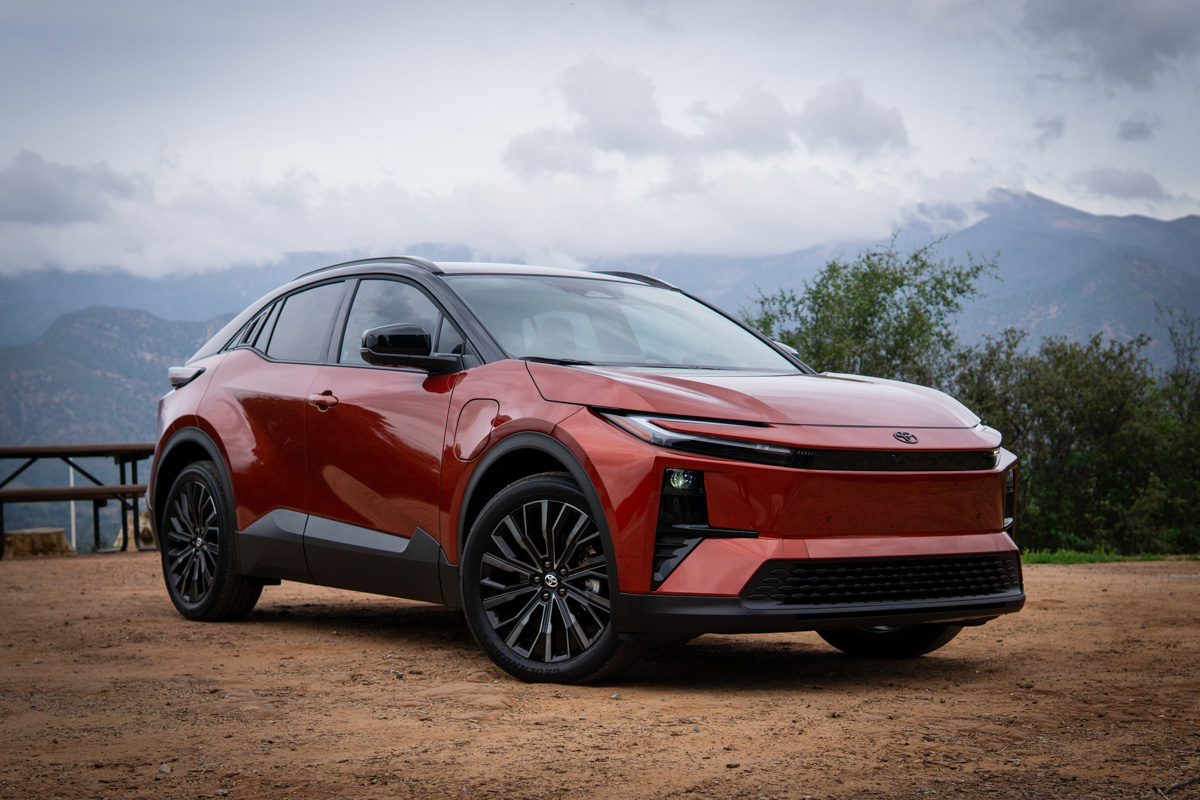
Like Frankenstein’s monster, electricity brings the Toyota C-HR back to life.
Toyota’s quirkiest model returns as a fully electric compact crossover that shares its platform and battery with the bZ Woodland but trades practicality for personality. With 338 horsepower, standard all-wheel drive (AWD), and a starting price of $38,450 (including destination), the 2026 Toyota C-HR offers an entertaining drive at a reasonable price.
Verdict: The 2026 Toyota C-HR won’t be the right fit for buyers who need lots of space, but it’s a genuinely fun electric crossover that doesn’t cost a fortune. If you’re an EV shopper who values driving enjoyment more than cargo capacity, the C-HR belongs on your shortlist.

For those who remember, the original Toyota C-HR is as likely to induce a grimace as it is a laugh. The old car looked like it was designed by committee, and while the new 2026 Toyota C-HR has less cohesive styling than a Tesla Model Y, it’s still a massive improvement on its predecessor.
Toyota calls it a “compact coupe silhouette,” which is marketing speak for a small crossover without a ton of rear-seat headroom or trunk space. Individual angles look good—the rear, profile, and front-quarter are all attractive on their own—but together, the C-HR is still a bit of a mishmash. Wide and low, measuring 177.9 inches long, 73.6 inches wide, and 63.8 inches tall, and riding on a 108.3-inch wheelbase, the C-HR maintains a tidy package that's designed to look sporty, at least in comparison with its platform mates, the Toyota bZ and bZ Woodland.
The hammerhead-style front fascia is becoming the family face across Toyota’s EV lineup, and it works well here. Things are busier around back—the C-HR wears both a split roof spoiler and a ducktail rear spoiler, which is one more spoiler than most cars need. It also boasts black roof rails, blackout badging, a lower rear diffuser, and color-keyed door handles with touch-sensor lock/unlock.
Toyota sells the C-HR in just two trims: SE and XSE. The XSE trim can be equipped with a two-tone paint option, and our test vehicle wore Tandoori (a shade of orange) with a Midnight Black Metallic roof.
Wheel choice is the other major exterior differentiator between the SE and XSE trim levels. The SE rides on 18-inch black alloy wheels, while the XSE gets striking 20-inch gunmetal multi-spoke wheels that genuinely elevate the C-HR’s appearance. Ground clearance measures 8 inches.
Inside, the C-HR mixes soft-touch materials with hard plastics, but fit and finish is excellent throughout. Our XSE tester’s SofTex upholstery was complemented by synthetic ultra-suede inserts that look and feel premium, although the suede is noticeably grippy. On a hot day—particularly with the optional panoramic glass roof overhead—that suede texture could be unpleasant against bare skin. A power sunshade helps, but it’s nonetheless worth considering if you live somewhere warm. A leather-trimmed steering wheel is standard on both the SE and XSE trims, and it’s a small but welcome upgrade over the SofTex-wrapped wheel Toyota uses in its other EVs.
The styling might not be for everyone, but overall the C-HR looks and feels as though it’s trying to be the sporty one in Toyota’s well-rounded EV family. And, for the most part, it succeeds.

The 2026 Toyota C-HR comes standard with dual-motor AWD, though the motor configuration differs from the bZ Woodland, which also has standard AWD. The front motor produces 167 kilowatts and 198 pound-feet of torque, while the smaller rear motor contributes 87 kW and 125 lb-ft. Combined system output is 338 hp, and Toyota estimates a 0-60 mph time of 4.9 seconds. That’s plenty quick, and like most EVs, the power delivery is smooth and immediate. The C-HR doesn’t demonstrate any hesitation upon accelerating, something you occasionally feel in vehicles that lean heavily on a single motor.
Where the Toyota C-HR shines is in corners. Toyota claims the C-HR’s suspension was tuned differently than that in the bZ and the bZ Woodland; unique spring rates, damper settings, and anti-roll bar stiffness rates make the C-HR more of a performance EV than those two. The result is a crossover that feels noticeably sportier than the bZ Woodland. Turn-in is sharp, and the steering is linear and well-weighted. The C-HR tracks through curves with confidence, and it’s one of the better-handling EVs in its price range.
The trade-off is ride quality. On the XSE’s 20-inch wheels, road imperfections transmit into the cabin with enough force to remind you that Toyota prioritized handling over comfort in the C-HR. The C-HR is a delight on smooth pavement, where it’s snappy, responsive, and quiet, but it's less refined on rougher surfaces. The SE’s 18-inch wheels with taller tire sidewalls likely offer a more forgiving ride, though we didn't test that configuration.
The 2026 Toyota C-HR shares the bZ Woodland's 74.7-kilowatt-hour lithium-ion battery. Toyota estimates 287 miles of range on the SE trim and 273 miles on the XSE, the decrease due to the latter’s larger wheels, and that 14-mile penalty is worth considering if range anxiety is a concern. During a backroad-heavy test loop, we saw 3.9 miles per kWh, which suggests that roughly 280 miles is a realistic expectation.
You can adjust the C-HR’s regenerative braking via the steering-wheel paddles, which feel great; they’re built from a high-quality plastic, make a satisfying click when pulled, and provide four levels of regen intensity. Downhill Assist Control is also standard on both trim levels.
Charging the C-HR should be an adequate if not exceptional experience. A Tesla-style NACS charge port is standard, and DC fast charging maxes out at 150 kW, which Toyota says can hypothetically take the battery from a 10% to an 80% state of charge in roughly 30 minutes—just understand that this estimate relies on an assumption of ideal conditions. Charging at home, an 11-kW onboard charger handles Level 2 charging systems, delivering a full battery in roughly 7.5 hours. Toyota includes a dual-voltage 120V/240V home charging cable plus a NACS-to-CCS adapter with the purchase of a C-HR.
Battery preconditioning activates automatically when you route the navigation system to a fast charger. However, this feature—tied to Toyota's Destination Assist—is free for only its initial three-year trial, after which battery preconditioning requires a subscription. That’s pretty disappointing, and it’s worth noting that while the C-HR’s charging story is an improvement over the first-generation bZ4X’s, none of this is class-leading. The Hyundai Ioniq 5 and Kia EV6 charge significantly faster.

Its coupe-style profile makes the C-HR look sporty, but it comes at a measurable cost inside. Rear legroom is decent at 32.2 inches, but rear headroom feels tight, particularly in models equipped with the panoramic glass roof. We checked the back seat while parked and found enough space for two adults, but foot room is tight, even if the legroom is manageable for six-footers. The middle position is an even tighter squeeze, making the C-HR a car best suited to couples or families with small children who won’t yet complain about snug quarters.
The rear seats fold down with a 60/40 split, and they also recline. Behind those rear seats, the C-HR offers 25.3 cubic feet of cargo space, which expands to 59.5 cubic feet with the seats folded. The Chevrolet Equinox EV is comparable, with 26.4 cubic feet that opens up to 57.2, but in reality, it doesn’t feel close. For anyone in need of more cargo space, we recommend the more expensive bZ Woodland.
Up front, the driver and passenger fare much better. The XSE provides eight-way power adjustment on both front seats, along with memory for the driver’s seat. The SE makes do with an eight-way power driver’s seat and a six-way manual passenger seat, one of the more noticeable cost-cutting measures at the base trim. Heated front seats and a heated steering wheel are standard on the SE and XSE, but ventilated seats are nowhere on the menu. The XSE can also add heated rear seats via the Cold Weather Package.
Four USB-C ports—two in the front and two in the rear—come standard. The front charging port offers 15 watts of power, while the two in the rear are 60-watt ports, good for keeping larger devices charged. Dual wireless Qi charging pads sit in the center console, and we were impressed by their charging speed and that they didn't overheat our phones. Dual-zone climate control is also standard.
The Toyota C-HR is not the vehicle to choose if cargo space or rear-seat comfort are priorities, but for a compact electric crossover, the front-seat experience is comfortable and well-equipped.

Every 2026 Toyota C-HR comes standard with a 14-inch touchscreen and a fully digital driver information display. The touchscreen, running the Toyota Audio Multimedia system, features wireless Apple CarPlay and Android Auto, Toyota’s “Hey Toyota” voice assistant, and a cloud-based navigation system with Google POI data, the latter two features offered via an initial three-year trial of Toyota’s Drive Connect software.
The touchscreen is reasonably responsive, particularly after the initial startup, and the interface is straightforward enough that most buyers won’t need long to get oriented. Fingerprints do show up easily on the screen, particularly when it’s set to the dark-mode display, so keep a microfiber cloth handy if smudges bother you.
Ambient lighting—in 64 colors—is also standard on both trim levels, adding a little extra personality to the cabin. Audio is another bright spot; the standard six-speaker system is decent (we sampled it in the bZ Woodland and came away pleasantly surprised by its clarity), but the XSE’s available nine-speaker JBL premium audio system (with an 800-watt amplifier and subwoofer) sounds excellent. The JBL stereo is a $600 option, but it’s a nice audio upgrade, so worth it if you have the cash.
Toyota leans heavily on connected services in the C-HR, as it does in many other models. The cloud navigation system works well and, as noted in the Performance section of this review, ties into the battery preconditioning feature. Over-the-air (OTA) updates are also supported.
The C-HR’s tech isn’t groundbreaking, particularly if you’re familiar with the tech offering in other Toyota models, but it’s also not frustrating. The essentials are covered, the screen works well, and the available JBL upgrade is worth the extra money. For a vehicle starting under $40,000, the tech holds its own against that of rivals from Hyundai and Kia, and surpasses what you’ll find in a Chevrolet Equinox EV.

Toyota Safety Sense 3.0 is standard on every 2026 C-HR. The suite of driver-assistance systems includes automatic emergency braking with pedestrian detection, full-speed adaptive cruise control, lane-departure and lane-keep assists, automatic high-beam headlights, and road sign recognition. Blind-spot monitors with rear cross-traffic alert and safe exit assist are also standard. Eight airbags round out the base safety equipment.
There is a gap in safety tech between SE and XSE, as the latter receives a surround-view monitor camera system, traffic jam assist, and lane-change assist, none of which are available on the SE. These aren’t minor upgrades, particularly the surround-view monitor. If these features matter to you, the $2,000 jump from SE to XSE trim may be a reasonable ask.
Neither the Insurance Institute for Highway Safety (IIHS) nor the National Highway Traffic Safety Administration (NHTSA) had published crash-test ratings for the 2026 Toyota C-HR at the time of writing.

The 2026 Toyota C-HR SE starts at $38,450, including a $1,450 destination fee. The XSE adds $2,000, coming in at $40,450 (again, destination included). The as-tested price of our XSE with the panoramic roof, JBL stereo, cold weather package, and two-tone paint job was $41,550.
That figure represents compelling value. The Hyundai Ioniq 5 now starts at $36,600 for the base SE trim with 168 hp and 245 miles of EPA-estimated range. Bumping up to an Ioniq 5 with competitive power and range lands you in an SEL or Limited, both of which start over $40,000. Similarly, the Equinox EV and the Nissan LEAF can be bought for less, but neither provides the C-HR's level of performance. The SE represents strong value on its own merits, and the case for upgrading to the XSE isn’t clear-cut, depending instead on the wants, rather than the needs, of the shopper.
Toyota backs every C-HR with a three-year, 36,000-mile warranty and a five-year, 60,000-mile powertrain warranty, plus an eight-year, 100,000-mile battery warranty. Additionally, ToyotaCare covers routine maintenance for two years or 25,000 miles. The warranty package is competitive but unremarkable, particularly when compared with the powertrain coverage offered by Hyundai and Kia.
The 2026 Toyota C-HR isn’t out to be the most practical or the most advanced EV in its class. What it offers is a genuinely fun driving experience and a price that undercuts much of the competition. That combination is enough to earn a recommendation, even if the cargo area and back-seat space remind you of its compromises in the name of style.

User reviews for 2026 Toyota C-HR
Write a reviewWhat users have asked
Top Comparisons
2026 Toyota C-HR Pricing
Trims & specs
Airbags
Dual front airbags · Dual front knee airbags · Passenger airbag deactivation: occupant sensing deactivation · Front side airbags · Front side curtain airbags
Brakes
Front brake diameter: 17.0 · Rear brake diameter: 17.0
Engine
EV battery capacity: 74.7 kWh · EV on-board charger rating: 11 kW · Electric Motor Battery Type: lithium ion · Electric Motor HP: 224 · Electric Motor Power Output (Kilowatts): 167 · Electric Motor Torque: 198
Steering
Steering ratio: 14.2 · Turns lock-to-lock: 2.8
Tires
Type: all season
Airbags
Dual front airbags · Dual front knee airbags · Passenger airbag deactivation: occupant sensing deactivation · Front side airbags · Rear side curtain airbags
Brakes
Front brake diameter: 17.0 · Rear brake diameter: 17.0
Engine
EV battery capacity: 74.7 kWh · EV on-board charger rating: 11 kW · Electric Motor Battery Type: lithium ion · Electric Motor HP: 224 · Electric Motor Power Output (Kilowatts): 167 · Electric Motor Torque: 198
Steering
Steering ratio: 14.2 · Turns lock-to-lock: 2.8
Tires
Type: all season

