2026 Mazda MAZDA3 Reviews, Pricing & Specs
Write a review--
Original MSRP
6.5
of 10
expert review
avg user rating
(0 reviews)
Pros
Available all-wheel drive
Stylish design
Fun to drive
Cons
Underwhelming base engine
Cramped back seat
Outdated technology
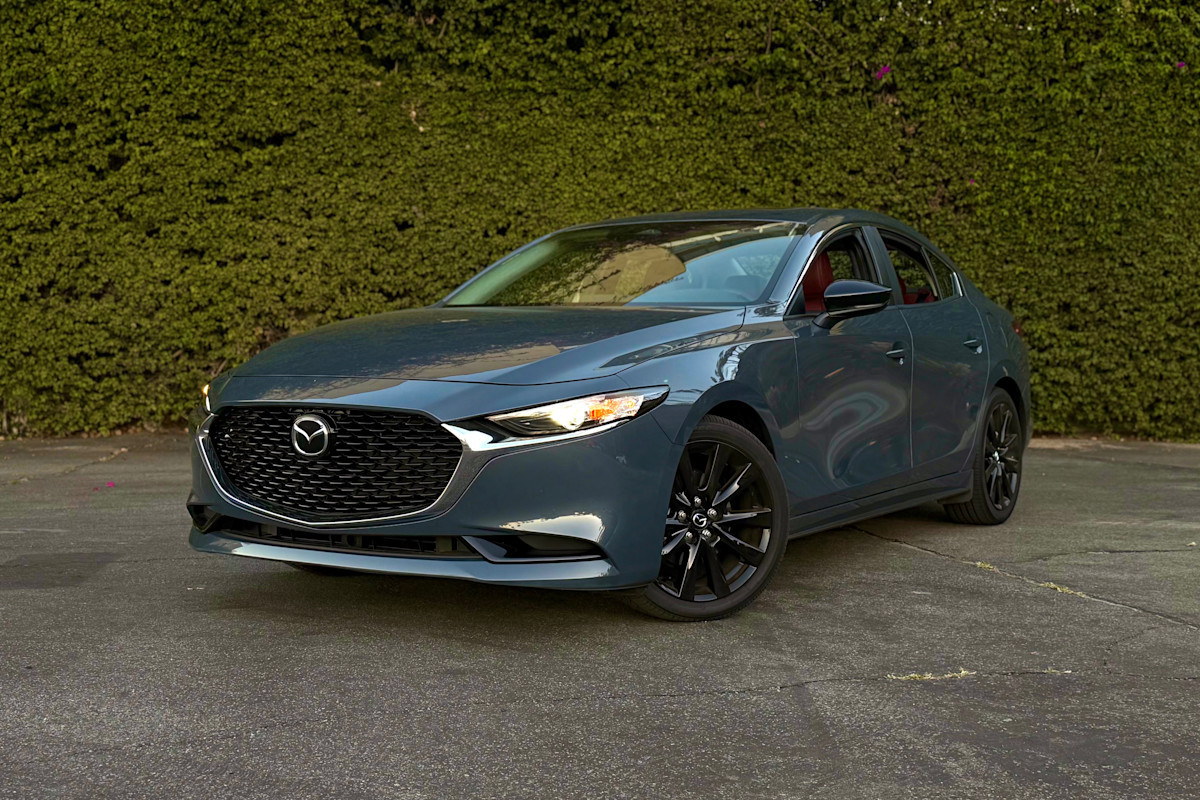
The Mazda 3 brings style and athleticism to an otherwise boring class.
Compact sedans are some of the most affordable vehicles today, which often leads to cheaper interiors, disappointing performance, and uninspired styling. The 2026 Mazda 3 bucks that trend with a cabin that could easily be mistaken for entry-level luxury fare, a spirited driving experience, and head-turning style. The current-generation Mazda 3 debuted as a 2019 model, but despite its age few updates are expected for 2026.
Verdict: The Mazda 3 proves that small cars don’t have to be boring.

From the outside, the 2026 Mazda 3 has an unmistakable family resemblance to other vehicles in Mazda's portfolio like the Miata and CX-5. Its large polygonal grille features a metallic frame that branches off to integrate the narrow headlights, giving the front fascia a more substantial and refined appearance than other sedans, which are defined more by their busy and plasticky styling.
The side view also sets the Mazda 3 apart from the rest, with gracefully sculpted panels instead of sharp creases and a shiny metallic strip that traces the shape of the windows. The wheels and tires fill the wheel wells for a sportier look that tricks your eyes into thinking the small sedan rides lower than it actually does. The rear end is as tastefully styled as the rest of the exterior, relying more on harmonious shapes instead of splashy novelties. The available Mazda 3 hatchback follows the same path, but with a more muscular stance. In a class known for economy, the Mazda 3 is the most distinguished-looking choice.
The accolades continue on the inside, with a cabin rivaling some entry-level luxury vehicles. The dashboard is tastefully designed, with the top section curving around the infotainment display and conventional buttons and knobs for climate control. The instrument panel also mimics traditional analog gauges, but the center circle is actually a digital display, offering the driver a familiar look with modern conveniences.
It's not all for show, either, as the Mazda 3's materials quality is noticeably nicer than anything else in the class. Soft-touch surfaces abound, and the genuine stitching in the dash and door panels lends it a more upscale personality. Our only nitpick is the top-most door panel section that resembles vinyl more than simulated leather, but even that is an improvement over its rivals. Helping matters is a solid underlying construction that is devoid of any creaks or squeaks. In our higher-trimmed Carbon Edition model, red leather upholstery adds a racier look that further sets the Mazda apart from the competition.

The 2026 Mazda 3 is offered with the choice of two drivetrains. Our 2.5 S Carbon Edition trim comes with the base 2.5-liter four-cylinder that produces 191 horsepower and 186 pound-feet of torque, shared with the 2.5 S, 2.5 S Select Sport, and 2.5 S Preferred trim levels. A six-speed automatic transmission is obligatory with the sedan, but the Mazda 3 hatchback is also available with a six-speed manual. Most models are front-wheel-drive (FWD), but all-wheel-drive (AWD) is standard on the Carbon Edition and 2.5 Turbo Premium Plus. The Turbo model increases output to 227 hp and 310 lb-ft of torque on regular unleaded fuel with forced induction. With premium, that climbs to 250 hp and 320 lb-ft of torque.
The base engine is adequately powered, but far from impressive. Mazda says it should accelerate the 3 to 60 mph in around 8.5 seconds, which is as slow as other base sedans in the class. When merging onto highways, we felt compelled to floor the pedal for extended periods to match the flow of traffic, but thankfully, the engine didn't sound as though it was being overstressed. The Turbo powertrain gathers speed more confidently and should reach 60 mph in only 6.5 seconds, according to Mazda, which is also comparable to other upgraded engines in the class.
The Mazda 3 is a standout in the compact sedan class for its optional i-Activ AWD system. AWD is standard on the Subaru Impreza hatchback, but that’s about it. Four driven wheels increases traction, making it a smart choice in regions with severe winter weather. But for driving enthusiasts, AWD can also deliver more excitement. Compared to front-wheel drive (FWD) rivals, the AWD Mazda 3 corners with much more confidence and stability. Instead of demanding all of the steering and acceleration from the front tires, the burden is shared between all four wheels for more sure-footed handling. For spirited drivers, that means you'll be able to get on the gas earlier when coming out of a curve.
Despite the Mazda 3's sharper handling, it still delivers a comfortable ride. Moderate bumps and potholes are smoothed over as well as other sedans do, making it well-suited for either the morning commute or for long road trips. Road noise is noticeable on coarse asphalt, and a slight wind flutter could be heard from the mirrors at highway speeds, but neither are intrusive or annoying. Overall, the Mazda 3 is the sporty choice in the class, with almost no drawbacks as a result.

While the Mazda 3 may get high marks for style and performance, it's not the most convenient or practical choice in its class. The front seats offer ample space for taller occupants, but the rear seats are best left to smaller passengers. There's just-adequate room for an average-sized adult, but there's little room to stretch out, and the accommodations could feel a bit cramped. That closed-in feeling is amplified with the hatchback and its thicker rear roof pillars, which also cause some large blind spots for the driver. If you need to shuttle smaller kids or infants, the lack of rear space could be especially limiting for safety and booster seats.
Behind the rear seats, the sedan's trunk can hold up to 13.2 cubic feet of cargo, which is about average for the class. With few intrusions from the wheel wells and hinges, that space is more usable than that figure suggests, and points are also awarded for the remote seatback releases and a nearly flat load floor with them stowed. The hatchback is a smarter alternative if you need more space, as it can hold as much as 20.1 cubic feet, and that volume opens into the passenger space for bulkier objects. Personal-item storage is also at a bit of a premium, with only moderately sized cupholders, door pockets, and a center armrest bin.

The Mazda 3 is also somewhat behind the times in technology. For many drivers, that may not be a significant drawback because what the infotainment system lacks in features, it makes up for with ease of use. The standard 8.8-inch infotainment display is small for its positioning just out of reach atop the dashboard. That said, it's well placed within the driver's sightlines to reduce distraction. It's also not a touchscreen. Instead, you use a dial controller that is mounted on the center console, like some of the older systems from the 2010s.
Higher trimmed Turbo models get a 10.25-inch touchscreen, but touch input is only enabled for Apple CarPlay or Android Auto, both of which operate wirelessly in those higher trims and come with a wireless charging pad, too.
The infotainment system is easy to use, and most will never need to consult the owner's manual thanks to its intuitive menus. Reactions are quick and the graphics are attractively simple, but if you're looking for the latest bells and whistles, you'll likely be disappointed. The standard eight-speaker Bose audio system also leaves something to be desired. The staging (your perception of where the sound is coming from) sounds rather hollow, as if you had a head cold, and the bass and clarity are also lacking. A 12-speaker Bose audio system is available on the top 2.5 Turbo Premium Plus trim level.
Much like other vehicles today, the Mazda 3 also comes with remote monitoring and control via a smartphone app, called Mazda Connect. For the 2025 model year Alexa Built-in was added, allowing for limited voice control for some features.

In crash tests conducted by the National Highway Traffic Safety Administration (NHTSA), the Mazda 3 sedan was awarded a five-out-of-five star rating in all evaluations. Likewise, the Insurance Institute for Highway Safety (IIHS) gave its highest score of "Good" in all crash tests, and both the sedan and hatchback received the highest Top Safety Pick+ award.
All 2026 Mazda 3 models come standard with the typical advanced safety features and driver assistance tech expected in any economical car, here branded as i-Activsense. Those features include: forward collision warning with automatic emergency braking, adaptive cruise control, lane-departure warning, lane-keep assist, automatic high beams, and a driver condition monitor. The Select Sport trim adds blind-spot monitoring with rear cross-traffic alert, The top 2.5 Turbo Premium Plus model adds adaptive headlights, a head-up display, lane centering, a surround-view camera system, and reverse automatic braking.
Almost all of the systems featured in the Carbon Edition sedan we drove functioned just as they should. On the highway, the adaptive cruise control exhibited uncomfortably delayed reactions to slowing traffic, though, resulting in harder braking and an occasional collision warning. Increasing the following distance didn't help matters, either, and left us nervous about getting rear-ended by following vehicles.

The 2026 Mazda 3 sedan has a manufacturer’s suggested retail price (MSRP) of $25,785 for the base 2.5 S trim and peaks at $38,570 for the range-topping 2.5 Turbo Premium Plus model. Hatchback pricing typically runs $1,000 above the equivalent sedan trim. The low to mid-range models are priced competitively against the Honda Civic and Toyota Corolla, but the Mazda is more expensive on the high end.
That price premium is easily justified by the potent Turbo engine and AWD, though. The Subaru Impreza is the only other AWD model in the class, and it's not nearly as refined or sporty as the Mazda. If AWD isn't on your list of priorities, you can also save a few thousand by opting for a similarly-equipped Hyundai Elantra or Kia K4.
Our Mazda 3 Carbon Edition test vehicle with AWD returns an EPA-estimated 30 mpg combined (26/35 mpg city/highway). The front-drive model gains one or two mpg across the board, while the more powerful Turbo models are estimated at 27 mpg combined (23/32 mpg city/highway). In the compact sedan class, the Hyundai Elantra has the best fuel economy, with a 36-mpg combined estimate, while the Toyota Corolla and Nissan Sentra should return 35 mpg combined, and the Honda Civic at 34 mpg combined. It's worth noting that all of those competitors except the Sentra are also available in more economical hybrid form. The AWD Subaru Impreza hatch is rated at a competitive 29 mpg combined.
Despite coming up short in on practicality and technology, the Mazda 3 remains one of our favorites in the class. It's more enjoyable to drive than most of its rivals, and even if you're not seeking performance, drivers will appreciate its stability and agility.


