2025 Volvo XC90 Reviews, Pricing & Specs
Write a review--
Original MSRP
8.3
of 10
expert review
avg user rating
(0 reviews)
Pros
Stylish design
Great safety ratings
User-friendly technology
Cons
Semi-autonomous driving not available
Top-tier sound system costs extra even on top trim
Volvo has had plenty of news this year, most recently with the introduction of the all-new, fully electric 2025 EX90. But that doesn’t mean the automaker is content to let its stalwart top sellers run on autopilot.
Volvo has had plenty of news this year, most recently with the introduction of the all-new, fully electric 2025 EX90. But that doesn’t mean the automaker is content to let its stalwart top sellers run on autopilot.
The second-generation XC90 gets its second substantial refresh for the 2025 model year. It’s still offered in Core, Plus, and Ultra trims and with a choice of mild-hybrid and plug-in hybrid powertrains, but Volvo has upped the ante. The midsize three-row gets updated styling, materials, and feature offerings, as well as some mechanical tweaks that aim to improve ride comfort and handling. We had the opportunity to experience the T8 and the B5 powertrains, both in Ultra trim, on a Volvo drive program in Europe.
Verdict: The Volvo XC90 was already quite a good vehicle. It’s earned its position as Volvo’s flagship SUV with oft-praised style and substance. For 2025, it has been made even better.

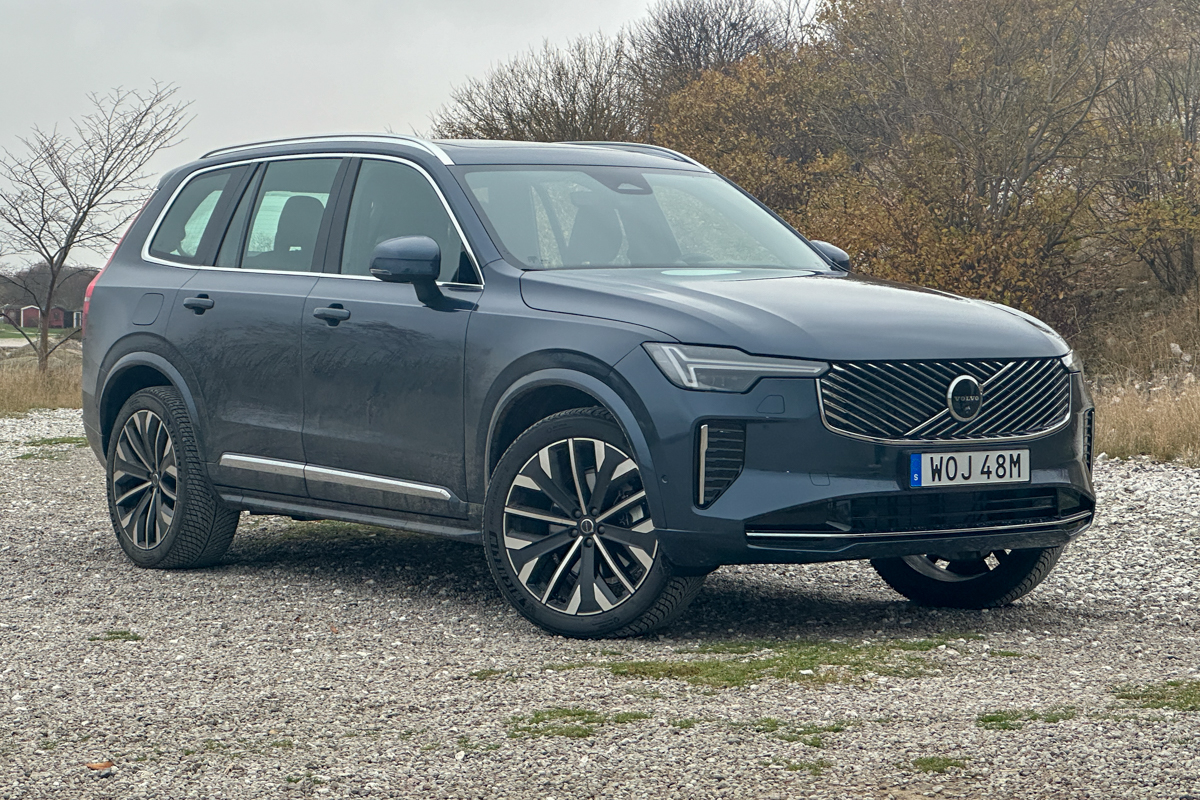
We gave the Volvo XC90 a rare 10 out of 10 for its timeless, elegant design in both 2023 and 2024, and we wouldn’t have blamed Volvo for saying “let’s not mess with perfection.” But this refresh has accomplished what we imagine the automaker set out to do: It’s kept all the great elements of the XC90’s look and just brought them along into the current moment. The new take on the signature “Thor’s Hammer” headlights, for example, makes them appear stronger and more deliberate, thanks to the precise outline surrounding them, without sacrificing any of the established identity. Similarly, while the grille is still the same shape, its character has been modernized through subtle changes. The old concave vertical bars, which bowed in toward the engine bay, are gone, replaced with diagonal and ever-so-slightly convex slats. The result is an almost woven-looking design that is also asymmetrical. It sounds like a terrible idea but somehow comes off looking sophisticated and fresh in practice.
We drove the B5 All-Wheel-Drive (AWD) mild hybrid in Denim Blue and the T8 eAWD plug-in hybrid (PHEV) in Bright Dusk. Both featured Volvo’s “Bright” exterior theme, with chrome trim elements signifying the automaker’s resistance to the siren call of flash-in-the-pan trends. Let other manufacturers be drawn into nouveau riche fashion–Volvo knows which side its bread is buttered on, and it’s staying firmly in the old-world elegance camp.
That doesn’t mean it can’t keep up with its customers’ expectations, of course. Both vehicles we drove were fitted with large wheels which nicely filled the arches: a 21-inch five-multispoke style on the B5, and 22-inch seven-double-spoke version on the T8.
The XC90’s interior is still the comfortable, understated space we’ve grown accustomed to–not plush, necessarily, but well-appointed from behind the steering wheel. There are several notable updates for 2025, however. For one thing, the infotainment screen now stands well out from the dash, though it’s still portrait-style and flanked by air vents. Where the padding of the center console used to extend past its opening and run all along the shift lever and cupholders on the driver’s side, it now ends with the cubby lid, making for a more symmetrical and spacious middle ground between driver and front passenger. The beautiful Orrefors crystal shift knob still delights us; it’s standard at the Plus and Ultimate trim levels.
We’ve often praised Volvo’s rich interior materials. There are now three choices for Plus and Ultimate, each with characteristically Swedish slant: quilted Nordico, perforated nappa leather, or herringbone weave textile. Nordico is a new synthetic leather upholstery offering, which we did not get to sample on this first drive. The genuine nappa leather option is the most premium and well-suited to seat ventilation with its perforated pattern, but the herringbone weave is the most news-worthy. Made of 100% recycled polyester, this new cloth seating surface replaces the popular wool option. We thought it looked great in Navy (the only color currently available), and it did prove nicely cozy upon vehicle entry in chilly northern Europe compared to a leather or leatherette option. Whether or not it will also stay cool in the summer, the way the wool famously did, remains to be seen.

Volvo continues to offer a choice of three powertrains in the XC90, all with standard AWD and an eight-speed automatic transmission. The effective base option is the B5, a four-cylinder engine operating with mild-hybrid support for improved fuel economy and smoother power delivery compared to the gas-only iterations that preceded it. The XC90 B5 is good for 247 horsepower and 266 lb-ft of torque. Next up is the B6. It’s still a mild-hybrid four-cylinder which requires only gas at refueling, but the B6 adds in turbo- and e-supercharging to bump power output up to 295hp and 310 lb-ft of torque. Finally, there’s the T8, a plug-in hybrid (PHEV) option which adds an electric motor and an 18.8-kWh battery pack to the system. Working in concert with the four-cylinder engine, this makes for a total system output of 455hp and 523 lb-ft of torque. The PHEV version of the Volvo XC90 was formerly known as the XC90 Recharge, and it’s important to note that it must be plugged in regularly to keep the battery charged and serving its fuel-saving purpose. The XC90 plug-in hybrid offers up to 33 miles of pure-electric range on a full charge.
We picked up our T8 test car fully charged, and plugging it in was not part of the scope of this relatively curated driving experience. We did experience Charge mode, however, which tells the vehicle to use some of the gas engine’s power to boost the hybrid battery’s charge level. This is a great option for those who prefer to reserve Pure electric drive mode for particular circumstances: driving through a quiet neighborhood late at night, for example.
The B5 and B6 are arguably the more user-friendly, hassle-free options, as you don’t have to worry about electric charger locations to avoid serious fuel-economy consequences (PHEV batteries do add weight, after all). In our B5-equipped test car, we also got to test out the updates to the XC90’s standard suspension. It now features Frequency Selective Damping (FSD) technology, which allows each damper to adapt mechanically to road conditions for improved ride comfort and stability. It really gave us no cause for complaint, even after testing out the electronically controlled optional air suspension, which in theory provides an even more comfortable and disciplined ride.

The new center console layout is not just an aesthetic shift, but a practical one as well. The wireless charging pad used to lie alongside the gear shifter, minimizing space for cupholders. Now, it’s moved to the area just below the center stack, so that a charging phone runs parallel to the dash rather than to the driver’s legs. This keeps it out of the way and out of sunlight, a welcome update if you’ve ever seen a phone overheat thanks to an unfortunate combination of amenities (in this case, a Qi charging pad and an open moonroof). The angle of the charging pad also helps keep the phone in place while the vehicle is in motion, and it’s now standard even at the Core trim level. We found the re-organization of this central area made small-item storage much easier in general.
First- and second-row USB-C charge ports are also standard, but third-row occupants get the short end of the stick on this front. They do at least get dedicated cupholders and a share in the view through the standard panoramic roof. As in just about any standard-wheelbase three-row, space for those two rear-most seats is tight, at 36.3 inches of headroom and 31.9 inches of leg room. That doesn’t sound so great compared to 38.9 inches of headroom for front-seat occupants and 38.5 for the second row, or to 40.9 inches of legroom up front and 37 in the middle. But in the context of midsize three-rows, the XC90’s way-back actually wins in the competitive set that typically puts it up against the Acura MDX, the Audi Q7, and the Infiniti QX60. Of these four, the Infiniti offers the most spacious front-row seats, and the award for roomiest second row goes to the Audi, but the Volvo is no slouch.

Positioning is not all that’s new for the XC90’s touchscreen infotainment system. It’s larger and offers sharper resolution, and it’s running the new user interface (UI) also seen in the electric EX90 which debuted earlier this year. Volvo reps we spoke with strongly emphasized the fewer-taps approach which resulted in surfacing more key functions to the homescreen. A larger and more quickly legible fixed menu bar lives at the bottom of the screen. As in the previous version, this ensures that the menu button and climate controls are always accessible, but it does so in a more user-friendly manner. A “contextual bar” just above that foundational system bar places frequently accessed functions at the user’s fingertips, too.
The infotainment system in the XC90 is still Android-based, with Google Built-In, but this should not deter Apple users. Apple CarPlay connectivity is also standard and worked seamlessly when connected both wirelessly and via USB-C cable. We did find that we liked using the native Google Maps, though, because we could continue to follow navigation directions on the 12.3-inch driver information display even when our passenger was managing our playlist on the center screen. Top-end Ultra trim adds a head-up display.
A proprietary 10-speaker High Performance stereo is standard, supplanted on the Ultra trim by a 14-speaker Harman Kardon Premium Sound system. Our test vehicles were equipped with the optional 19-speaker Bowers & Wilkins High Fidelity audio system, which can be added at the Ultra trim level for an extra $3,200. That’s four times the cost of adding the Harman Kardon system to the mid-range Plus trim, but audiophiles won’t find it hard to justify the extra expense. The top-tier sound system offers four distinct listening modes–Studio, Individual stage, Concert hall, and Jazz club–each excellent in its own way.

The 2025 Volvo XC90 is too new to have been crash-tested by independent safety organizations, but its predecessors as well as the automaker itself have established quite the reputation. The 2024 XC90 earned a Top Safety Pick+ award from the Insurance Institute for Highway Safety (IIHS), that non-profit’s highest honor. It also scored top marks from the National Highway Traffic Safety Administration (NHTSA), with five stars overall. Of course, Volvo as a brand has been known for safety, long before it added understated elegance to its halo. It’s perhaps for this reason that the XC90 errs on the cautious side, aiming for functional rather than fancy.
Functional, it nails. The standard advanced driver-assistance systems (ADAS) operated smoothly and, during our two-day test drive, never interfered erroneously with our driving. Adaptive cruise control, lane-keeping aid, lane-departure warning, and the blind-spot information system all worked as we’d want them to. Fortunately, we didn’t have reason to experience active collision-avoidance features like intersection auto brake or large animal detection, but the XC90 has these, too. What it doesn’t have is a hands-free highway-driving system like those we’re seeing on other midsize three-rows–and more affordable ones, too. The Kia Telluride, Hyundai Palisade, Chevy Traverse, and Ford Explorer all offer level two semi-autonomous driving systems, even if the technology isn’t standard.

The least-expensive version of the 2025 Volvo XC90 is the B5 in Core trim, which is a seven-seater. Base MSRP for this configuration sits at $59,745 after destination–perilously close to $60,000, but still technically below that benchmark. Opt for the boosted B6 powertrain, the middle trim, or six seats (a captain’s chairs configuration, with a second row of seats and a pair of third-row rear seats), and you’re well into the mid-$60k range. At the high end is the plug-in hybrid XC90 T8, which will run you $81,995 in Ultra trim with captain’s chairs in that middle row. The T8 also offers the best fuel economy, at an EPA-rated max of 27 mpg, always assuming you remember to plug it in when necessary.
Perceptions of the Volvo badge’s prestige are interestingly varied. Some consider it mid-level, while others feel it falls solidly into luxury SUV territory. We categorize it mentally as the “stealth wealth” option–high-quality, but never ostentatious. Walking that line, Volvo has few true rivals, if any, so it’s necessary to move beyond perception for the purposes of objective evaluation. Traditional competitors of the XC90 include the Acura MDX, the Audi Q7, and the Infiniti QX60—but you could easily add the Lexus RX, the Mercedes-Benz GLE, and the BMW X5 to that list. The MDX and QX60 offer more affordable entry points, both starting closer to $50,000. The Q7’s pricing is closer to the XC90’s, though it stretches up almost to $90,000 at the top end without the plug-in hybrid option here in the US. For the shopper seeking the perfect fit or the ideal balance of price and comfort, both quite precise and personal bullseyes, these vehicles are all worth a look. For our money, though, nobody does quite luxury quite like Volvo, and with the facelifted XC90, the automaker has outdone itself—at least this side of the opulent, all-electric Volvo EX90.