2024 Mazda CX-50 Reviews, Pricing & Specs
Write a reviewPros
Stylish design
Standard all-wheel drive
Classy interior design
Cons
Fairly pedestrian performance
Noisy (Meridian Edition)
Poor value for money
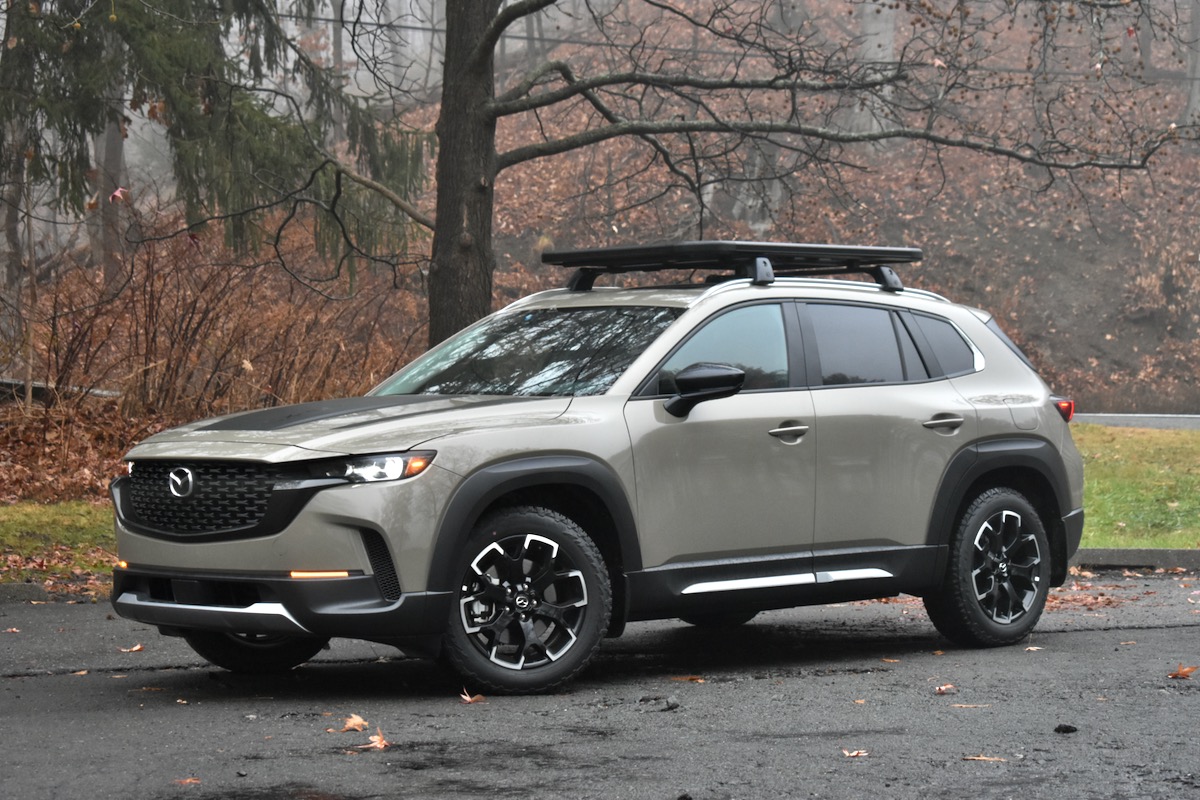
This small crossover SUV aims to balance ruggedness with everyday usability.

The CX-50 is a more rugged counterpart to the Mazda CX-5. But Mazda didn’t just throw on some plastic body cladding and call it a day. The CX-50 is 1.4 inches lower, 3 inches wider, and 5.7 inches longer than the CX-5, with a 4.6-inch wheelbase stretch. The broad-shouldered proportions are emphasized by square wheel arches and fake air vents below the headlights and taillights. New for 2023, the CX-50 is also a fresher design than the CX-5, which debuted in its current form as a 2017 model and hasn’t changed much since then.
For 2024, the CX-50 is available in no less than eight trim levels: 2.5 S Select, 2.5 S Preferred, 2.5 S Premium, 2.5 S Premium Plus, 2.5 Turbo, 2.5 Turbo Meridian Edition, 2.5 Turbo Premium, and 2.5 Turbo Premium Plus. Lower trim levels get 17-inch wheels, with 20-inch wheels available on most of the higher grades. Other than that, there isn’t much to distinguish a 2.5 S Select from a 2.5 Turbo Premium Plus when it comes to styling.
Our test car was a 2.5 Turbo Meridian Edition, which takes the CX-50’s active-lifestyle image even further with all-terrain tires mounted on 18-inch wheels, a black hood graphic, and more pronounced rocker-panel trim. A roof platform and splash guards are also available as part of the optional Apex Package. It’s basically Mazda’s equivalent to the Kia Sportage X-Pro, Subaru Forester Wilderness, and Toyota RAV4 TRD Off-Road. Unlike those models, though, the Mazda didn’t make any changes to the suspension or add drive modes to enhance off-road capability beyond what’s available on other trim levels.
The CX-50 Meridian Edition at least looks the part thanks to an earthy color palette including Polymetal Gray Metallic or Zircon Sand Metallic paint and Terracotta leather upholstery. The interior design is pleasing as well. The infotainment screen sits on a little shelf, like in a BMW, and material quality and fit and finish were impressive for a non-luxury brand. Mazda also thankfully kept the piano black plastic trim to a minimum, meaning the CX-50 interior will likely age better than those of some rivals.
However, the CX-50 doesn’t quite match up to Mazda’s aspirations. The automaker has been trying to move away from the mainstream and become a more upscale brand for some time, and CX-50 shows that’s still a work in progress. Standard half-leatherette seats (leather upholstery is optional) are a step up from a Toyota or Honda, but base models’ manually-adjustable front seats are a reminder of where Mazda has traditionally been positioned in the marketplace.

All CX-50 models use a 2.5-liter four-cylinder engine, with turbocharging on higher trim levels. The base naturally-aspirated version produces 187 horsepower and 186 pound-feet of torque. The turbo engine is rated at 256 hp and 320 lb-ft of torque on 93-octane gasoline and 227 hp and 310 lb-ft on 87-octane fuel.
A six-speed automatic transmission and all-wheel drive (AWD) are standard on all models. Normal, Sport, and Off-road driving modes are standard as well, with a Towing mode on turbo models. Those models also up towing capacity from the standard 2,000 pounds to 3,500 pounds.
The CX-50 shares powertrains with the Mazda CX-5, but the two compact crossovers offer very different driving experiences. The CX-5 exemplifies Mazda’s old “Zoom Zoom” ethos of sporting driving dynamics, while the CX-50 feels more like the other models in this segment. The CX-50 is a good daily driver, but it won’t make you want to take the long way home like the CX-5.
Not helping in the handling department were our Meridian Edition’s all-terrain tires. They would have been useful in mud or snow—if we’d found any—but otherwise produced limited grip and higher-than-average noise. Extra noise is inevitable with all-terrain tires, and something you’ll also experience in similarly shod rivals like the Kia Sportage X-Pro and Toyota RAV4 TRD Off-Road. But the Meridian Edition’s roof platform also added some wind noise to the chorus at highway speeds. The CX-50 was pretty well-mannered otherwise, so unless you plan on using chunky tires and a roof platform, it might be best to skip this model.

The 2024 Mazda CX-50 has about the same passenger space as its Mazda CX-5 sibling, with slightly less headroom and slightly more legroom in both the first and second rows. The similarly sized Ford Escape, Honda CR-V, Kia Sportage, and Subaru Forester all have a bit more headroom than the CX-50. The Mazda comes close to those rivals in legroom across both rows, with two inches more rear-seat legroom than the Toyota RAV4.
The spec sheet lists 31.4 cubic feet of cargo space with the rear seats in place and 56.3 cubic feet with the rear seats folded. The latter figure is an even three cubic feet less than the maximum for the CX-5, but the CX-50 has a bit more cargo space than its sibling with the second row up. Both Mazdas trail the competition in cargo space for the most part, although the Subaru Forester has a bit less space than either model with its rear seats up.
Cargo-area access is made a bit easier by an available power liftgate, but there’s really nothing else adding functionality to match the Meridian Edition’s more rugged looks. The cargo area isn’t a friendly place for dirty or bulky items, and the optional roof platform is high enough to make shorter people think twice about using it.
Some more durable interior materials up front also would have been more appropriate for the Meridian Edition, but buyers with less-active lifestyles will find a sensible layout and adequate storage space. And that’s with both a substantial shifter and Mazda’s trademark rotary infotainment controller on the center console. Some automakers have shrunk or removed shifters to free up console space, but Mazda proves that’s not necessary.

A 10.25-inch infotainment screen is standard, but it isn’t a touchscreen like in most cars. Instead, a rotary controller and some buttons on the center console are used to cycle through the menus. Wireless Apple CarPlay is also standard, but Android Auto users must bring a cable (Mazda does at least provide dual front and rear USB ports to plug it into). Higher trim levels also get wireless phone charging, SiriusXM satellite radio, and a 12-speaker Bose audio system.
Mazda’s unorthodox touchscreen-free interface takes some adjustment if you’re coming from most other new cars, but it’s not any less awkward once you are acclimated. Located near the shifter, the rotary controller is easy to reach from the driver’s seat. And unlike a touchscreen, it provides some physical feedback. So it’s easier to use without having to take your eyes off the road.
That being said, tech-savvy buyers won’t find much excitement here. The infotainment system feels dated, with plain graphics and only the most basic functions. But that also makes the CX-50 a good choice for buyers who don’t want to be overwhelmed by excessive tech. If you’re using Apple CarPlay or Android Auto, does it even matter what the native system’s graphics look like?

The CX-50 was named a 2023 Top Safety Pick by the Insurance Institute for Highway Safety (IIHS)—the organization’s second-highest safety award. The CX-50 received the top “Good” score in all IIHS crash tests, a “Good” score for optional headlights, and the highest “Superior” score for front-crash prevention tech in the vehicle-to-pedestrian daytime test. However, it received the lowest “Basic” score for the nighttime version of that test, and the standard headlights were only rated “Average.”
Complete National Highway Traffic Safety Administration (NHTSA) safety ratings for the 2024 model year weren’t available at the time of publication. The CX-50 received a five-star frontal crash-test rating and four-star rollover crash-test rating, but the NHTSA did not publish side-crash and overall safety ratings.
Mazda covers the bases when it comes to safety features. Standard driver-assist tech includes automatic emergency braking, blind-spot monitoring, rear cross-traffic alert, adaptive cruise control, lane-keep assist, lane-departure warning, a driver attention monitor, and emergency lane-keeping with road-keep assist. Rear automatic braking, traffic-jam assist, and a 360-degree camera system are optional. Those features are also nice to have, but everything you really need is standard.

With the base non-turbo engine, the CX-50 gets an EPA-rated 27 mpg combined (24 mpg city, 30 mpg highway). Fuel economy drops to 25 mpg combined (23 mpg city, 29 mpg highway) with the turbocharged engine. These numbers are reasonable, but it’s worth noting that most rivals also offer a more-efficient hybrid powertrain option.
Mazda’s warranty coverage—including a three-year, 36,000-mile, new vehicle warranty and five-year, 60,000-mile, powertrain warranty—is comparable to Japanese and American brands. The Korean duo of Hyundai and Kia continue to offer a longer 10-year, 100,000-mile, powertrain warranty and five-year, 60,000-mile, new vehicle warranty.
Pricing starts at $31,675 for the base 2.5 S Select trim level (including a mandatory $1,375 destination charge) and climbs as high as $44,675 for a 2.5 Turbo Premium Plus model. Our 2.5 Turbo Meridian Edition test car had a $42,175 base price, but a few options gave it an as-tested MSRP of $43,960 with destination.
Mazda has been trying to move upmarket recently, which means it basically skips the lower trim levels offered for other compact SUVs. The CX-50 makes up for that somewhat by offering a decent amount of standard equipment. For example, only the Mazda and the Subaru Forester offer standard AWD; other competitors’ base models have front-wheel drive (FWD). But it would still be a stretch to call the CX-50 a great value.
If you’re interested in a Mazda, it’s also worth considering the CX-5. It’s close in size to the CX-50, has many of the same good points, and is a bit cheaper. The base CX-5 2.5 S Select is $1,000 less than the CX-50 2.5 S Select. And the top CX-5 trim level—the 2.5 Turbo Signature—is $2,700 less than the range-topping CX-50 Turbo Premium Plus. So unless the CX-50’s more rugged styling really speaks to you, the CX-5 is worth a look.


