Used 2011 Honda CR-Z for Sale Nationwide
24 results


About 2011 Honda CR-Z
Overview
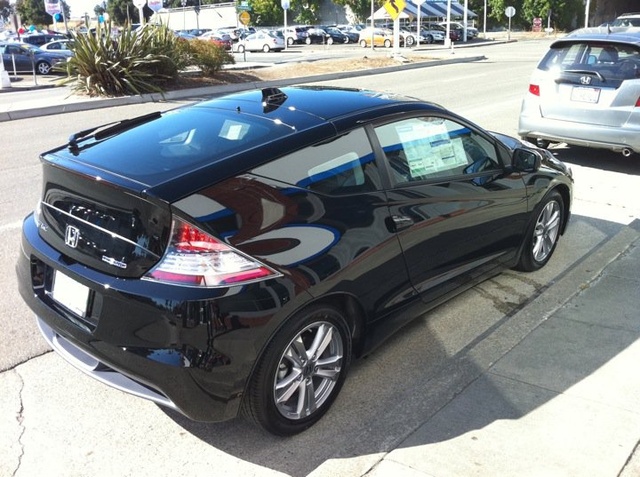
Whereas overseas the CR-Z offers 2+2 seating – in theory at least – here it’s a two-passenger, two-door hybrid hatchback. Its single powertrain, a 1.5-liter inline four paired with a brushless DC electric motor, is mated to either a six-speed manual transmission or a continuously variable transmission (CVT) in both Base and EX trims. Inspired by the CR-X and derived from the Fit and Insight, the CR-Z aims to add sporting appeal to the hybrid arena.
The chassis is a truncated version of the Insight's, with a wheelbase chopped down more than 4.5 inches for a total of 95.8 in the CR-Z. Overall, the CR-Z measures 160.6 inches, and it stretches up to a 54.9-inch height, but despite these shrunken proportions, the CR-Z weighs within 100 pounds of the Insight, topping off at a curb weight in excess of 2,600 pounds.
With a combined power output of only 122 hp, don’t expect the CR-Z to define “sport” in the hybrid segment. At least its 128 lb-ft of torque – 123 if you choose the CVT – arrive at only 1,000 rpm and stay pretty constant until 5,000. Peak horsepower doesn’t show up until 6,000, but I wouldn’t stick around that long if I were you, as things get rather uncivilized after 5,000 rpm, and in the worst of ways. The engine is increasingly loud and unpleasant the further you push past the 5,000-rpm mark, enough that you’ll want to forgo the last grand of the powerband.
So high performance isn’t this hybrid’s forte. Honda has been gracious enough to offer three drive modes, selectable by push button on the dash. Normal, Sport and Econ modes illuminate the dash in blue, red or green accordingly. Each setting offers unique throttle, steering and power profiles that sadly range from “not that sporty” to “not that efficient.” Truly, EPA estimates for the CR-Z fail to impress, with 31/37 mpg for the six-speed manual and 35/39 for the CVT.
Project leader Norio Tomobe claims he used his BMW 325i as the benchmark for the feel of the CR-Z’s electric power steering system, and when in Sport mode, the steering feel is quite good, but falls far short of its benchmark. Normal and Econ modes provide noticeably different feels, but none combats the excessive roll and lean that are evident when attempting to actually drive the CR-Z in a sporting manner. No surprise here, as they made an effort to stiffen the chassis, but utilized the same suspension found under the Insight – MacPherson strut front and rear torsion beam. The rear suspension has been adjusted here, and both front and rear tracks have been widened, resulting in better handling than the Insight's, but again we’re falling far short of "sport." The same can be said for the hydraulic/regenerative braking system. It’s not bad, and in fact it’s entirely competent, but it’s certainly not sporty or even confidence-inspiring.
And don’t forget the disturbing blind spots to the rear corners, an unfortunate result of the car's dramatically sloping roofline.
In all, the CR-Z is an interesting foray into the sport-hybrid segment, but ultimately falls flat. A Mugen version will reportedly be out next year, and this will hopefully address at least the sport side of the equation, but I can’t imagine it’ll help the economic side as well. Meanwhile, best of luck to Honda as they look for a demographic that wants a mildly sporty, sort of efficient two-seat hatchback.
4.5 Overall rating
Filter by rating
Ian S
Reviewed a 2011 Honda EX on Dec 12, 2010
Awesome well packaged coupe that actually evokes the spirit of my old CRX-I wish Honda had a traditional gasoline engine or the European turbo diesel under the hood; I think I might be the first person to buy a hybrid that did not buy it for that reason. This car is perfect for me-Thank you Honda! - I love my CRZ EX 6MT-it corners well, gets awesome gas mileage, looks cool as hell and is fun to drive. Just point it and aim-have fun rowing through the gears while getting great fuel economy. It reminds me of my CRX Si's from 86 and 91 in many ways (dashboard cubby from mk1, glass window on hatch mk2) with all of today's modern features-Bluetooth and a USB port for my IPOD and 3 different selectable driving modes I can chose from-economy car on the highway, normal in the city and Sport for back country roads make this 3 cars in one. The UPSHIFT/DOWNSHIFT lights are not annoyingly bright like I've experienced in other cars, and I try to get as many leaves on the tree as possible by driving efficiently. I look forward to many years with my CRZ; Thanks Honda! Either way, I look forward to years of enjoyment with this baby.
Alfred W
Reviewed a 2011 Honda EX with Nav on Apr 24, 2015
This little Honda coupe looks great and makes driving fun. It has all the electronic gadgets one could wish for, shiftable automatic CVT transmission with Paddle shifters on steering wheel. Automatic climate control. 3 modes to choose from: Econ, Normal, Sport. All this and great mpg - I get 50 mpg on the highway!
Anonymous
Reviewed a 2011 Honda Base on Nov 26, 2013
Great for a daily commuter. Fun to drive and has decent performance. I feel safe and in control driving it. Some blind spots while backing out of parking spots, so I added a reverse camera. Had more fun driving the CR X but this is a different time.
Nathan S
Reviewed a 2011 Honda EX with Nav on Jun 14, 2013
We bought this car as a second vehicle for my wife to drive in early to work. Fell in love with how it drives and ended up driving it more than our first car. Lots of heads turned out way whenever we drove it around town. I love how the seats hug you and it eliminated my wife's carsick feelings on curves. I would recommend this car for to anyone!
2011 Honda CR-Z Trims
| Trim type | MSRP |
|---|---|
| Base | $19,345 |
| EX with Nav | $22,705 |
| EX | $20,905 |
2011 Honda CR-Z Price Trends
CarGurus tracks the prices of millions of used car listings every year. See how the average price of 2011 Honda CR-Z prices has changed over time.
See more price trends
